Ilyra
The Swift
- Cycle
- 8 days
- Diameter
- 1,800 km
- Distance
- 45 planet radii
- Tidal pull
- 1.0×
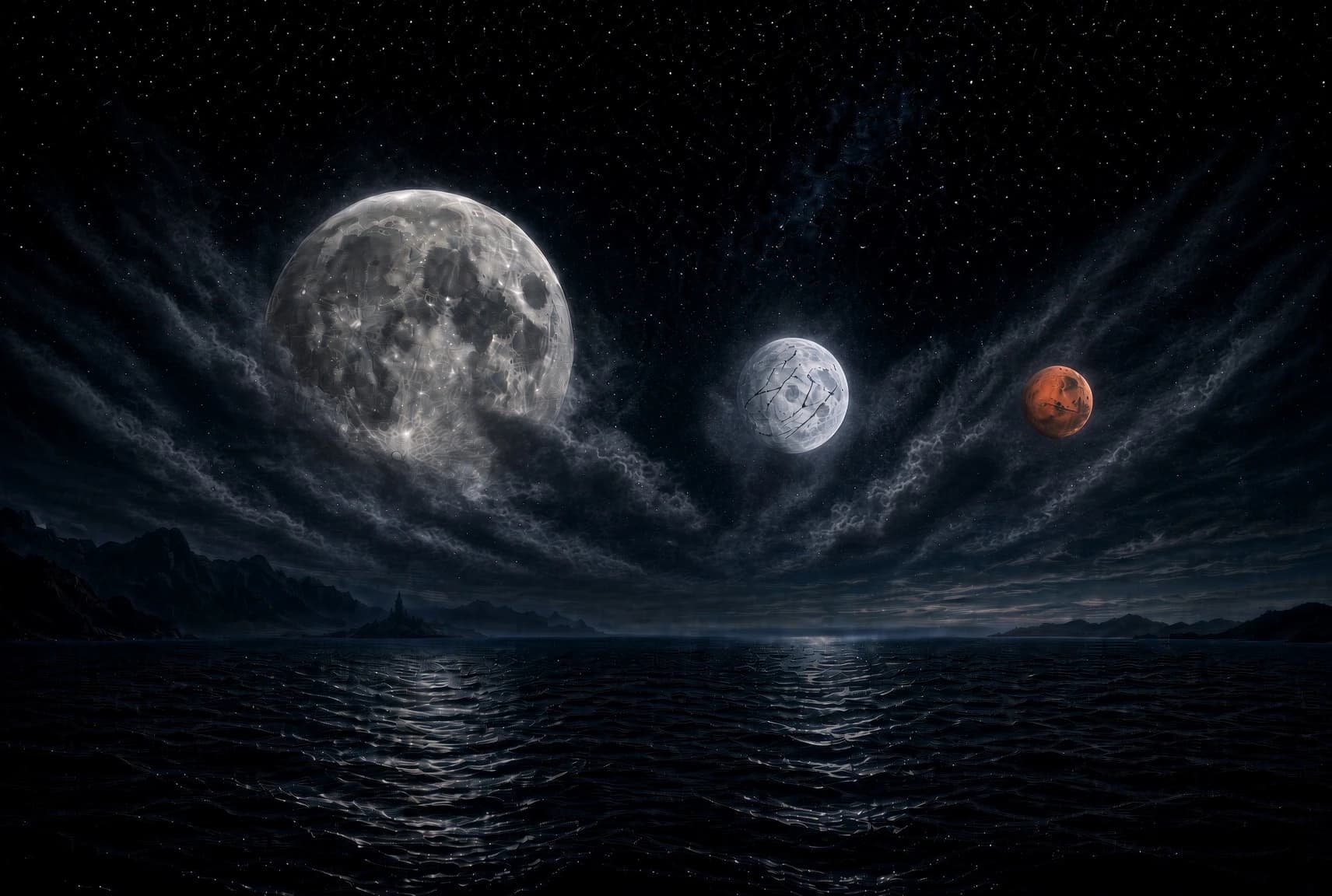
Innermost, brightest, largest in the sky. Strongest tidal driver. Cycles through phases every 8 days — the source of the Swift Week.
Helion · G2V (Sun-analog)
A world four-fifths ocean, held between two continents and bridged by a volcanic island arc — and pulled, every hour of every day, by three moons locked in resonance.
The chain
Ilyra, Morwen, and Elandra sit in a near-perfect 1:2:4 resonance. Every eight days the inner moon comes back around; every sixteen the middle one meets it; every thirty-two all three line up and the sea answers.
Ilyra
The Swift
Innermost, brightest, largest in the sky. Strongest tidal driver. Cycles through phases every 8 days — the source of the Swift Week.
Morwen
The Steady
Intermediate. The most Moon-like presence in the sky. A 16-day cycle used for the practical civil month by most surface calendars.
Elandra
The Distant
Outermost, slow-moving, a smaller silvery disc. A 32-day cycle marking longer ritual and seasonal periods; associated with fate and deep time.
Every 32 days the three ticks land together — a triple new moon, the highest tides of the cycle, and an auspicious day to begin almost anything.
The map
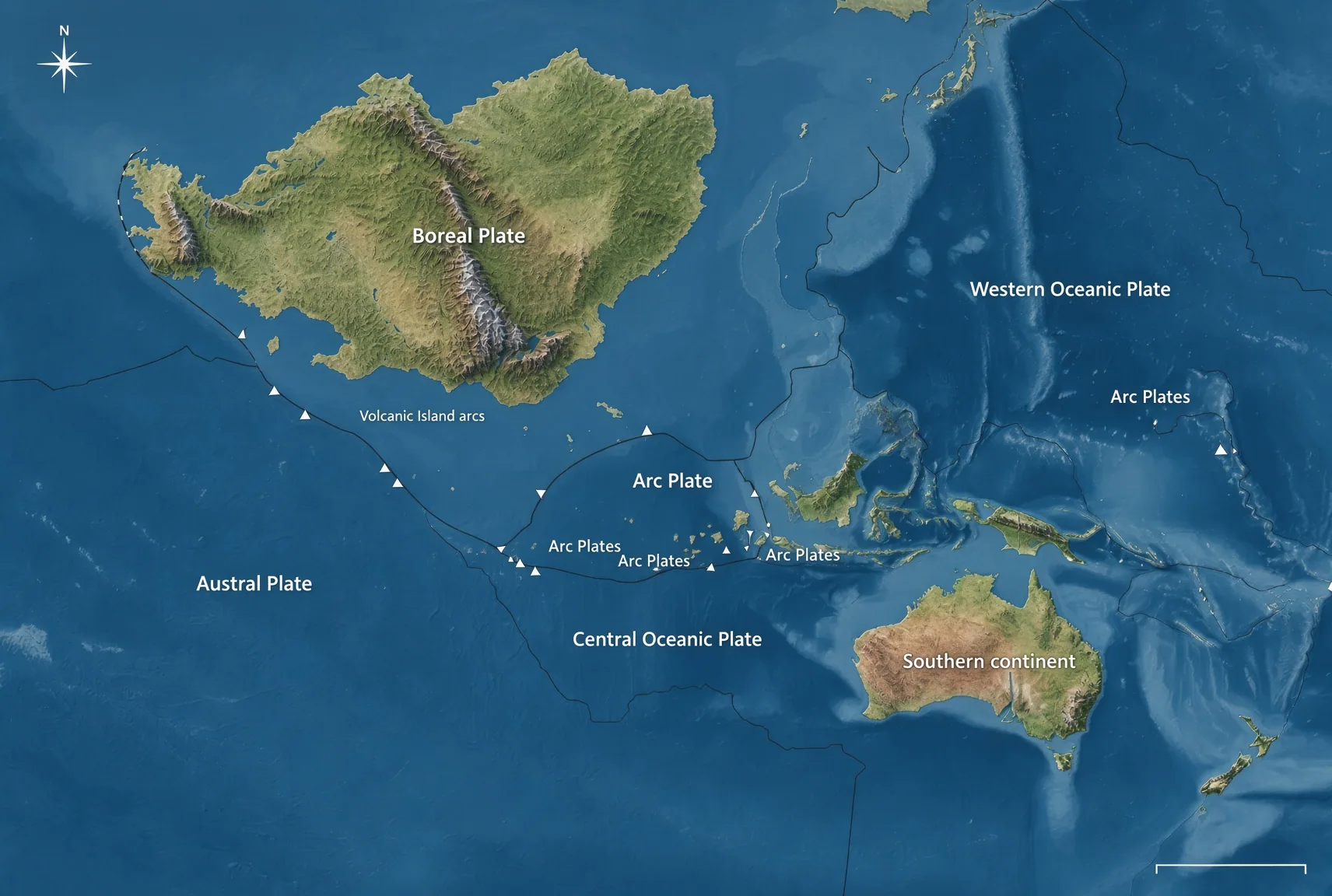
The world bible stops at four broad regions on purpose — the kingdoms, ports, and isles inside them are yours to name.
The Boreal Continent
fertile coasts and plains
The larger, northern/western continent — extensive coasts, forested interiors, tectonically raised metal-rich mountain ranges. Maritime coastal zones grade into greater seasonal range and rain-shadow steppe in the limited interior. Higher latitudes support temperate forest grading into boreal woodland and tundra.
The Southern Continent
fertile coasts and plains
The smaller, warmer, more equatorial/southern continent. Fewer old-growth forests; stronger subtropical and arid interior influences; important northern approaches to the island chains. Monsoon-like seasonal rains along the northern margins; volcanic highlands with sharp wet-windward / dry-leeward contrasts.
The Arc Islands
island chains and straits
The connecting archipelagos between the two continents — tropical to subtropical, volcanic, humid, storm-swept, and strategically vital. The most mixed and contested zone on Thalor: whoever holds the key straits of the Arc Throughflow controls trade between the two continents. Rich marine and coastal ecosystems fed by tidal upwelling and volcanic nutrients.
The Open Ocean and Deep Waters
open ocean and shelves
The vast pelagic zones between continents and archipelagos, plus the continental shelves. Aquatic humanoid dominance is absolute here — the deep is not a place surface fleets pass through without acknowledgement. Subduction-related trenches at the deepest reaches host aboleth cities, sunken temples, and worse.
The powers
Three moons that are also gods, a world-ocean, a mountain that walks, and the things in the trench that answer when they are called.
Ilyra
CNthe Swift Moon
change · speed · opportunity · sudden fortune or disaster
chaos / luck / travel
Exploration, Fate, Protean, Seasons, Trade
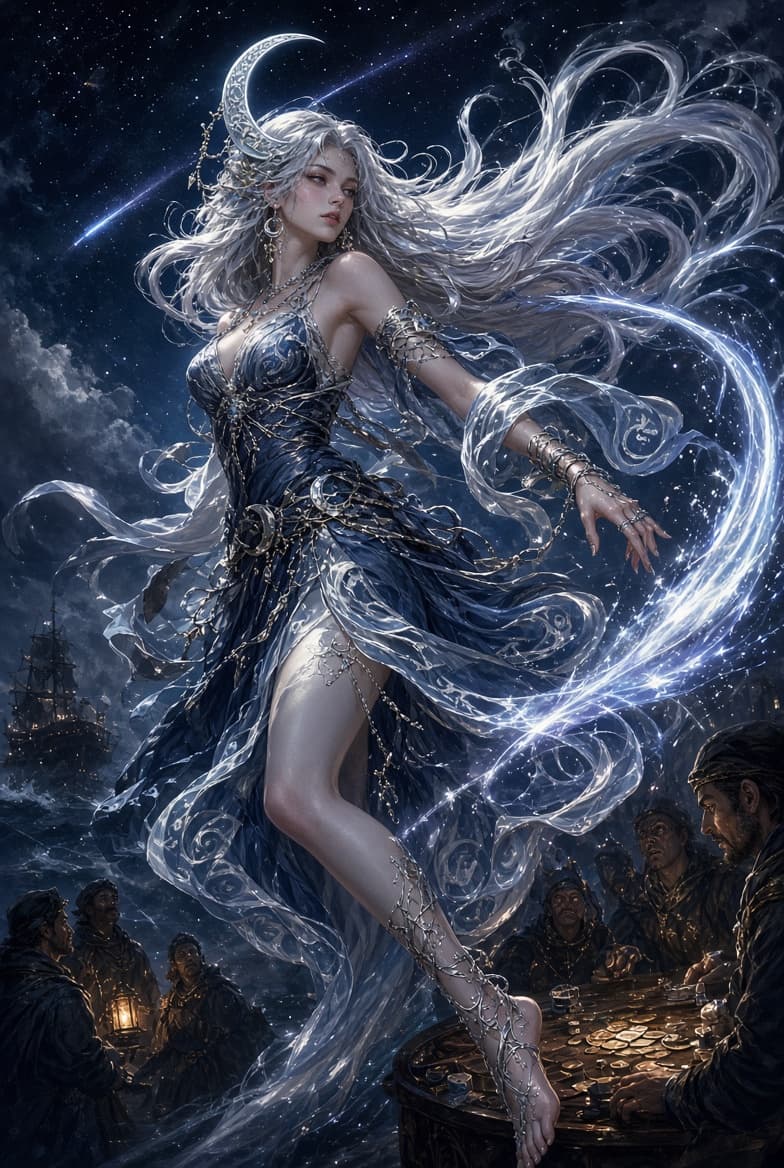
Ilyra races across the sky on an 8-day cycle, the brightest and most unpredictable of Thalor's three moons. She is the patron of those who live by the tide tables and the sudden turn of fortune—sailors, gamblers, messengers, freebooters, and halfling merchants. Her priests watch the rapid phase shifts for omens of opportunity or disaster and teach that hesitation is the only true sin. Temples are often little more than open-air tide pools or shipboard shrines; major festivals coincide with her full moons and any multi-moon alignment that promises chaotic tides.
Morwen
LNthe Steady Moon
cycles · navigation · oaths · endurance
law / protection / travel
Loyalty, Oceans, Resolve, Trade
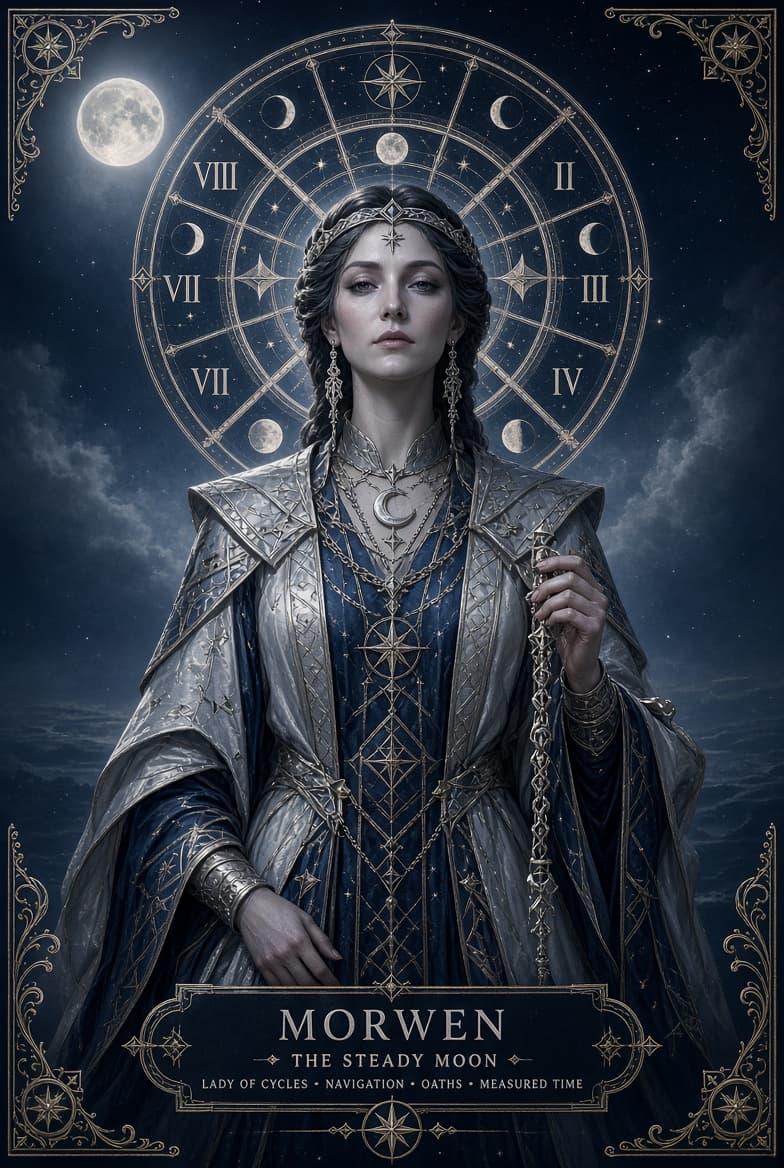
Morwen's 16-day cycle provides the most practical “month” for surface calendars and is the moon most often invoked for binding agreements and reliable navigation. She is the goddess of the Moonfall Compact and of contracts that must outlast storms and politics. Her temples frequently double as observatories, contract houses, and safe-harbor shrines. Clergy of Morwen are expected to keep precise records of tides, currents, and treaties; many navigators and civic officials on both continents and the island chains revere her.
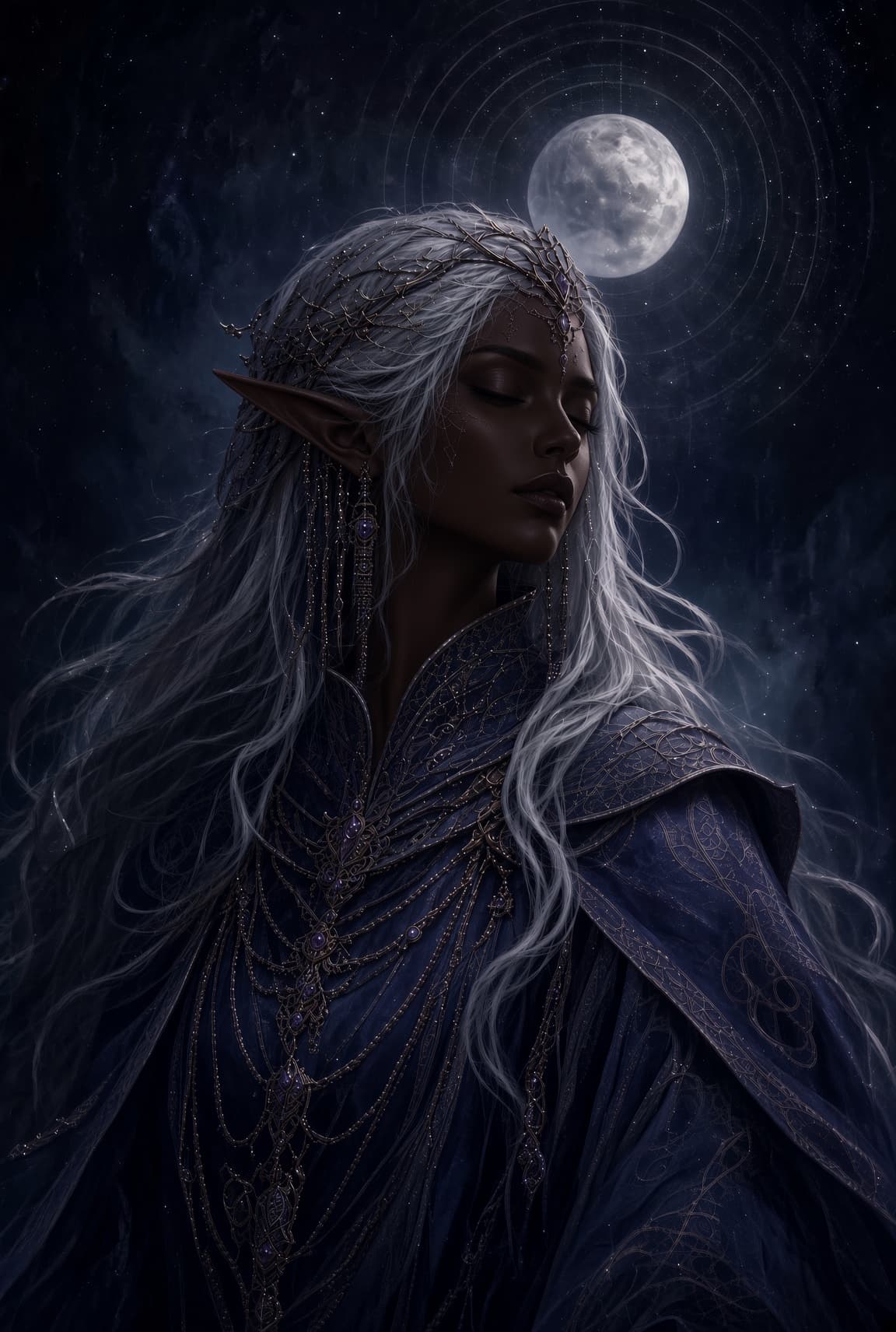
Elandra
Nthe Distant Moon
fate · secrets · long memory · the deep past
knowledge / magic / repose
Ancestors, Memory, Thought, Wards
The slowest and most distant of the three moons, Elandra is associated with deep time, forgotten lore, and the slow turning of destiny. Surface elves and aquatic elves both claim strong ties to her; oracles, historians, and ruin-delvers seek her guidance. Grand alignments and rare triple-moon events are frequently read as her distant will. Temples tend to be quiet, circular, and often built over ancient sites or near places where the three moons can be observed simultaneously.
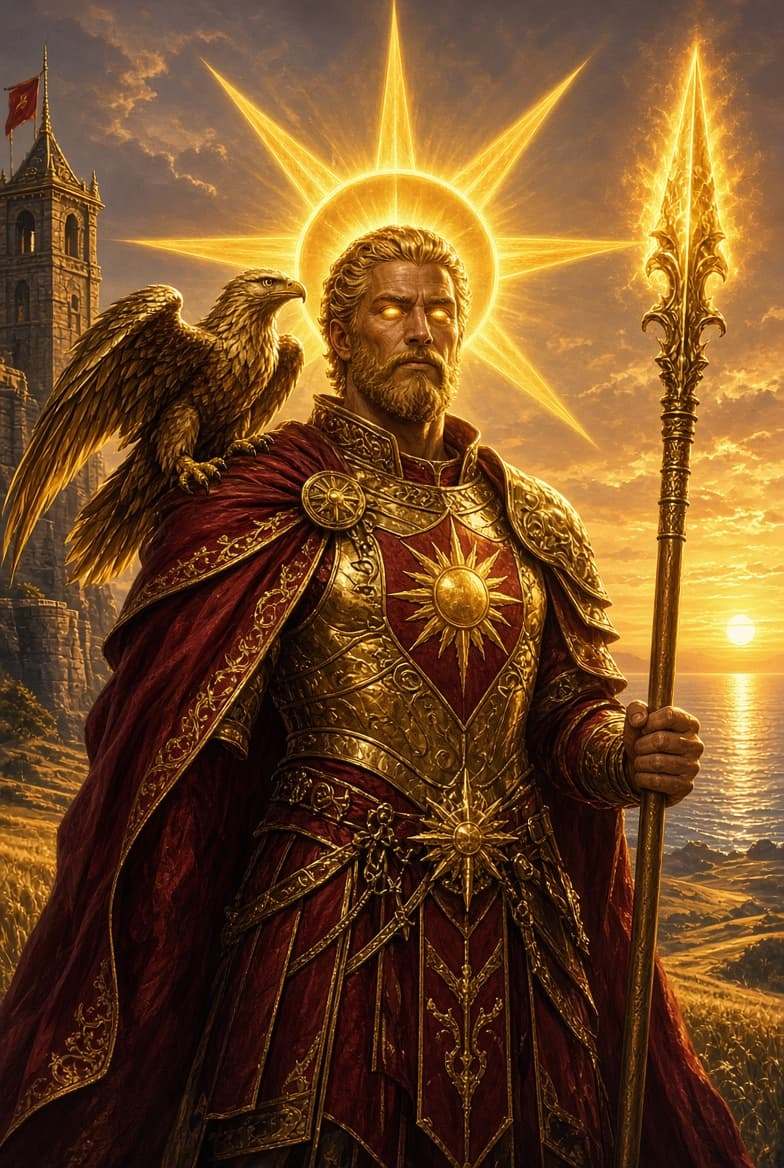
Solthar
LGthe Enduring Sun
light · seasons · harvest · vigilance
sun / law / protection
Loyalty, Fields, Resolve, Dawn
Solthar's steady path and the turn of the seasons give surface folk their clearest measure of the year, the daytime counterpart to Morwen's 16-day lunar month. He is the god of the Compact's daylight obligations, of harvests gathered before the storms, and of watchfires that must never be allowed to die. His temples double as granaries, sun-dials and high watchtowers, and often as courts where oaths sworn at dawn are held especially binding. His clergy keep the planting times and the solstices, and revere a light that outlasts both night and politics.
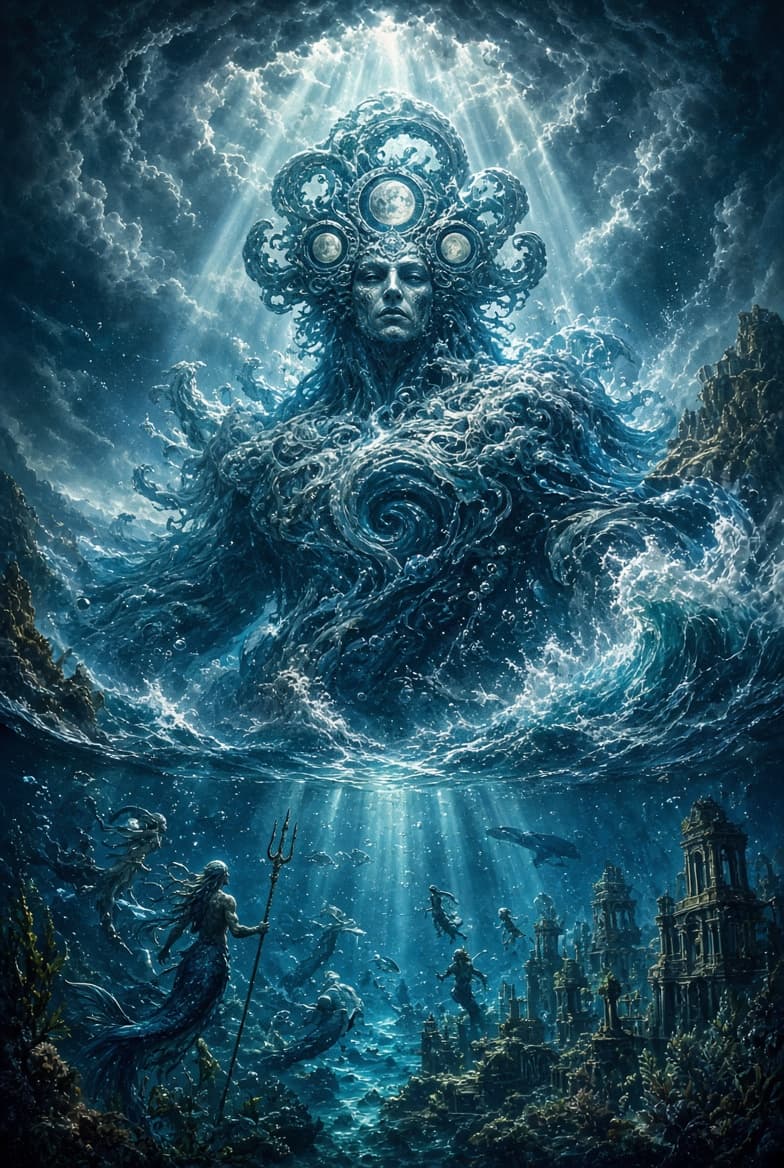
Thalorath
Nthe World-Ocean
oceans · tides · storms at sea · marine life
water / weather / animal
Catastrophe, Oceans, Storms, Trade
Thalorath is the closest thing Thalor has to a world-spirit—vast, impersonal, and inevitable. Merfolk and aquatic elves place the deity at the center of their worship; surface seafarers propitiate Thalorath for safe passage and fear the god's indifference more than any active malice. Offerings are cast into the water. Major temples stand on cliffs overlooking the sea or float as sacred barges. The god is neither benevolent nor malevolent; the ocean simply is.
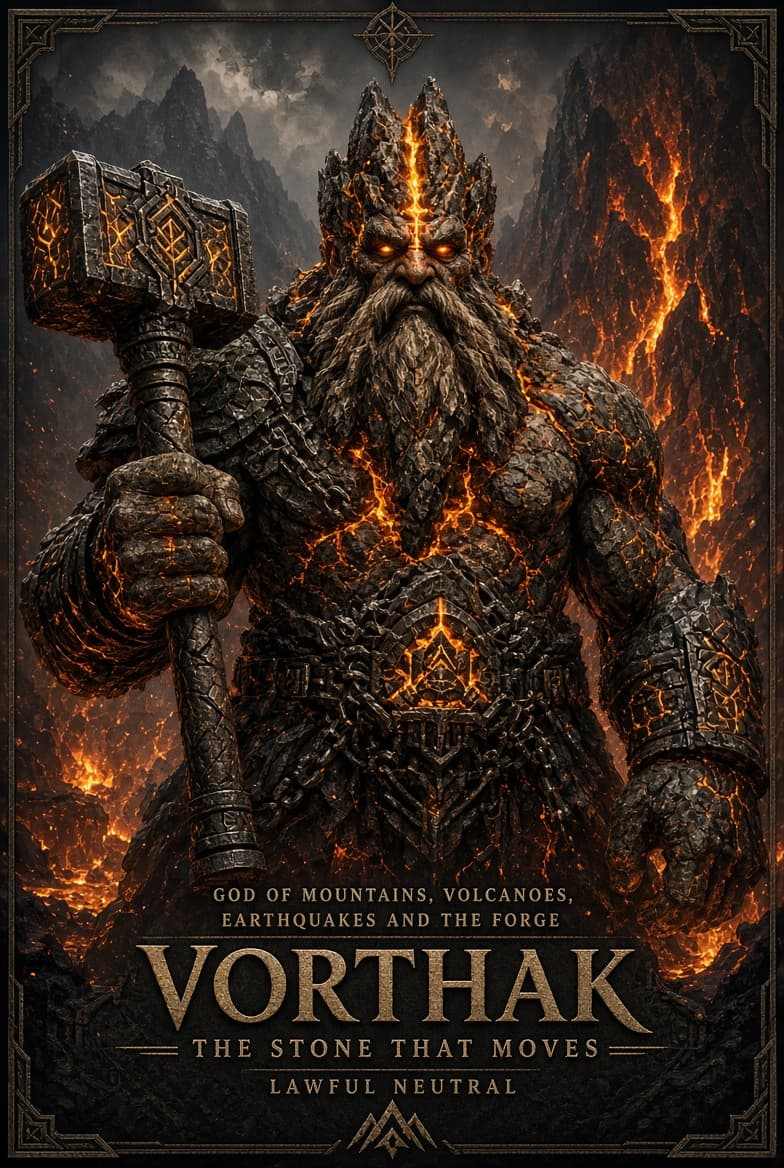
Vorthak
LNthe Stone That Moves
mountains · volcanoes · earthquakes · the forge
earth / fire / artifice
Caves, Metal, Resolve, Toil
Vorthak embodies Thalor's restless geology and is the chief deity of the dwarves. Miners, smiths, and highland peoples pray to quiet eruptions, bless new forges, and endure the planet's constant seismic activity. Island volcanoes frequently host shrines. Dogma emphasizes endurance, craftsmanship, and the understanding that stone itself is never truly still.
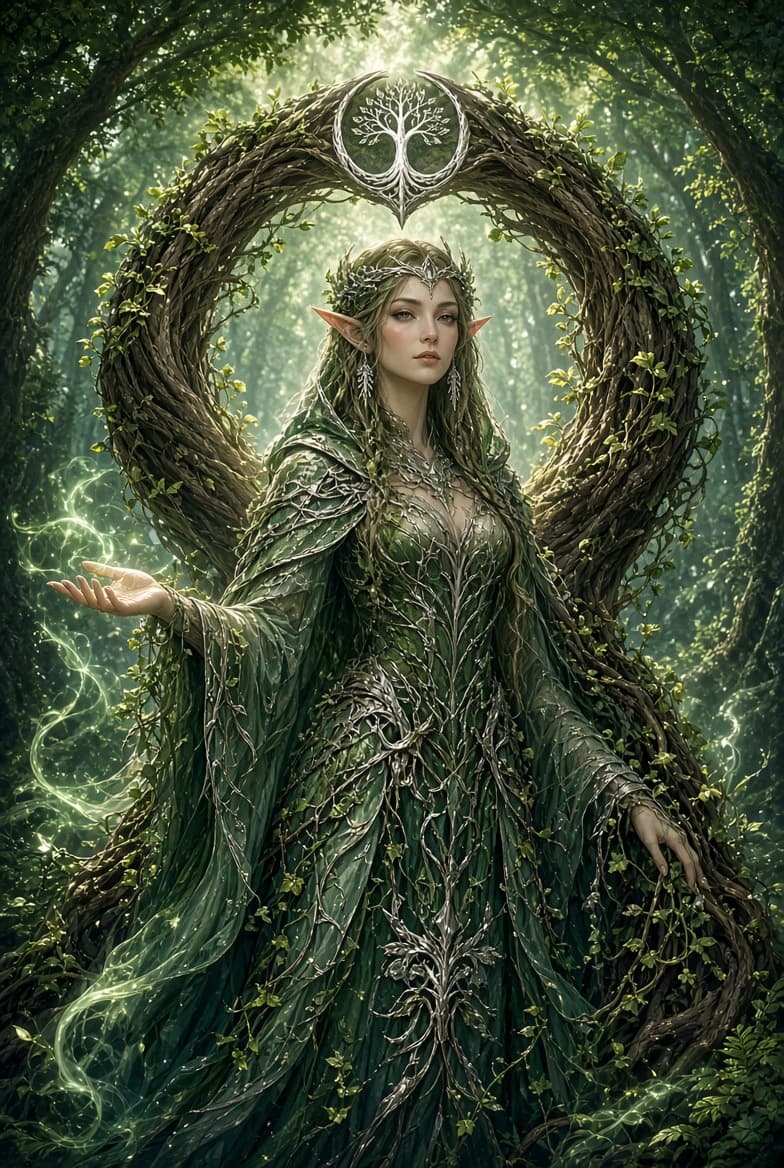
Sylarae
NGLady of the Green Veil
forests · growth · ancient memory · the living land
plant / animal / healing
Growth, Restoration, Seasons
The primary elven deity of the Boreal forests, Sylarae represents continuity and the slow wisdom of living things. Her clergy often mediate between expanding human settlements and remaining wild lands. Aquatic elves sometimes honor a parallel aspect tied to kelp forests and reefs. Temples are living groves or carefully tended woodland clearings rather than stone structures.
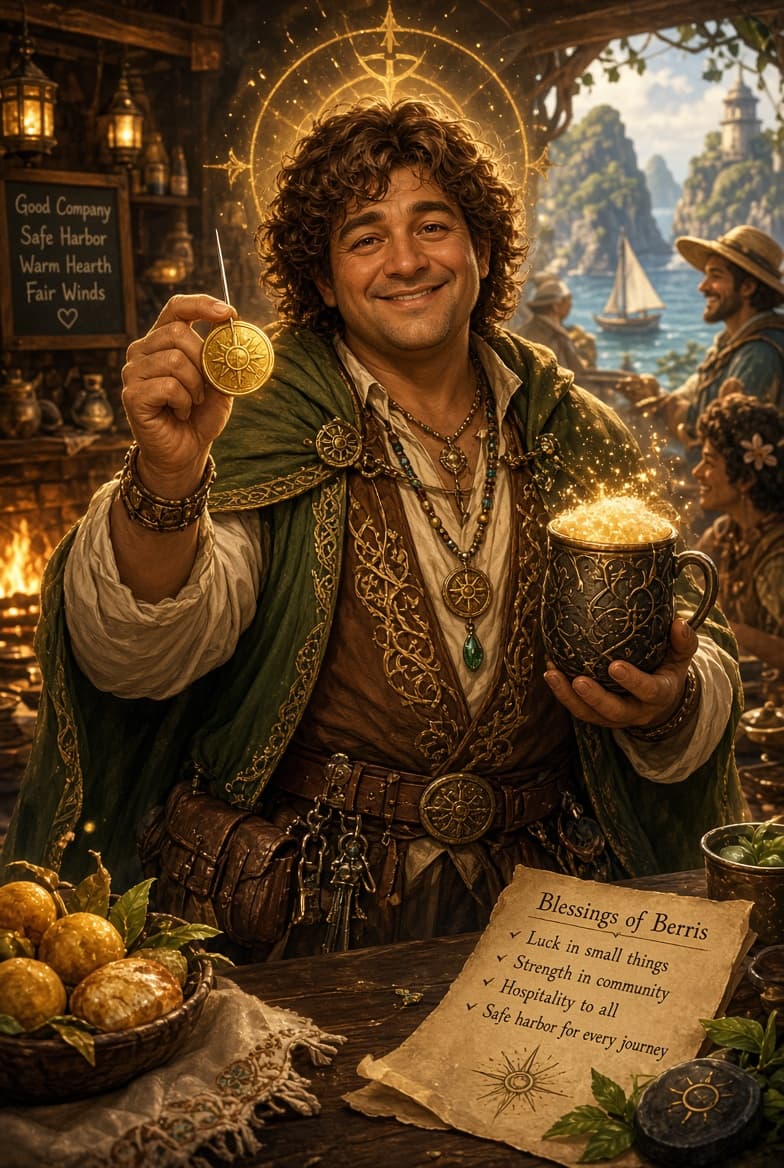
Berris
NGthe Fortunate
luck · community · hospitality · small joys
luck / community / good
Family, Home, Trade
The most widely beloved of the “smaller” gods, Berris stands at the center of halfling faith and is honored across mixed human-island towns. Invoked for fair winds, good harvests on limited island soil, and the everyday luck that keeps communities alive. Temples are often inns, market halls, or simple harbor shrines that double as places of hospitality.
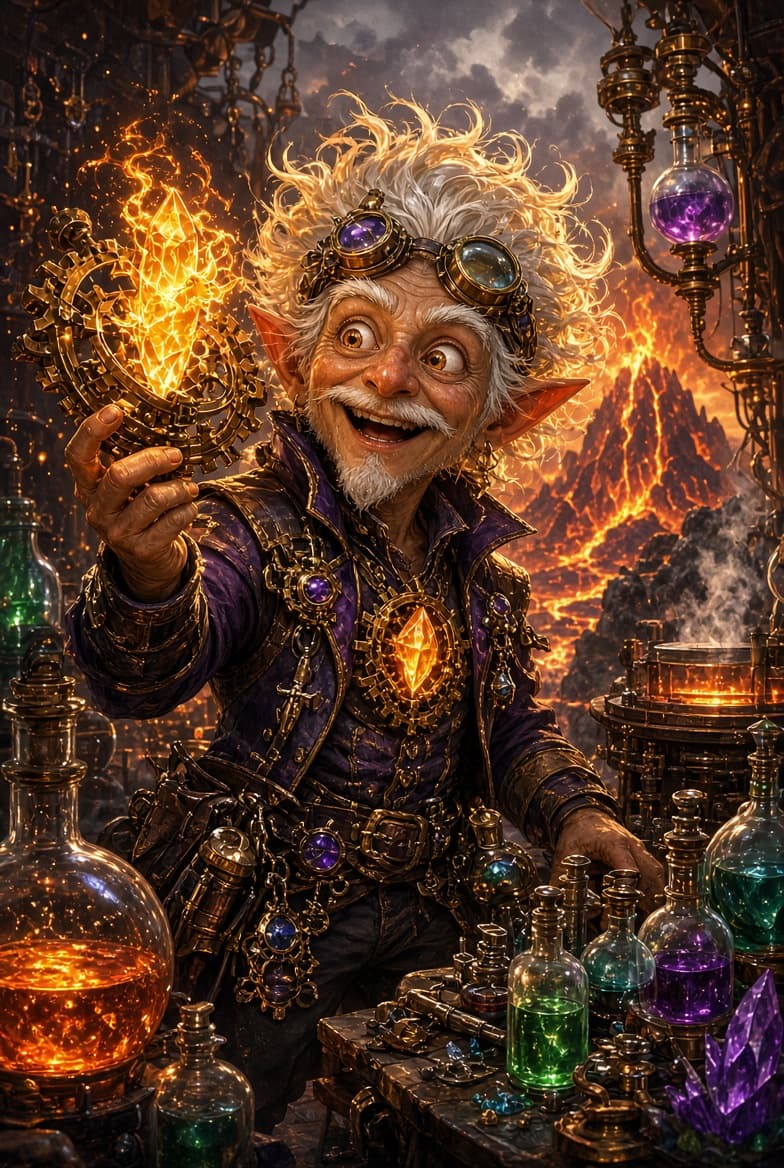
Nyzel
CNthe Spark
invention · curiosity · sudden insight · alchemy
knowledge / artifice / magic
Alchemy, Construct, Imagination, Smoke
Strongly associated with geothermal vents, volcanic islands, and the strange interplay of tidal and geological magic. Gnomes treat Nyzel as their patron. The god encourages experimentation—sometimes with explosive results. Workshops and academies on active volcanic isles frequently double as temples.
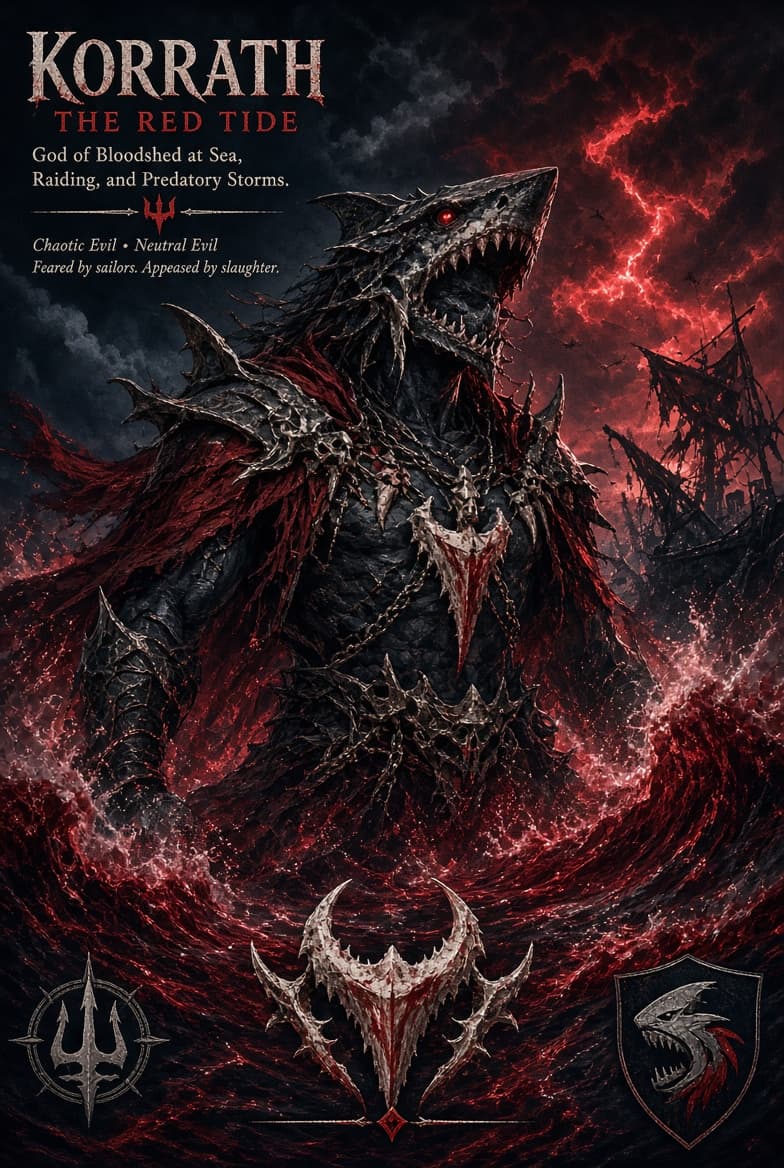
Korrath
CEthe Red Tide
bloodshed at sea · raiding · predatory storms · the devouring deep
war / destruction / water
Blood, Catastrophe, Oceans, Tactics
A darker sea power often blamed for the worst excesses of the Strait Wars. Not universally worshipped, but feared and propitiated. Elevated as a primary deity by some island raiding cultures, aggressive merfolk factions, and certain orc and half-orc freebooters. Temples are rare and usually hidden; most offerings are made at sea with blood and wreckage.
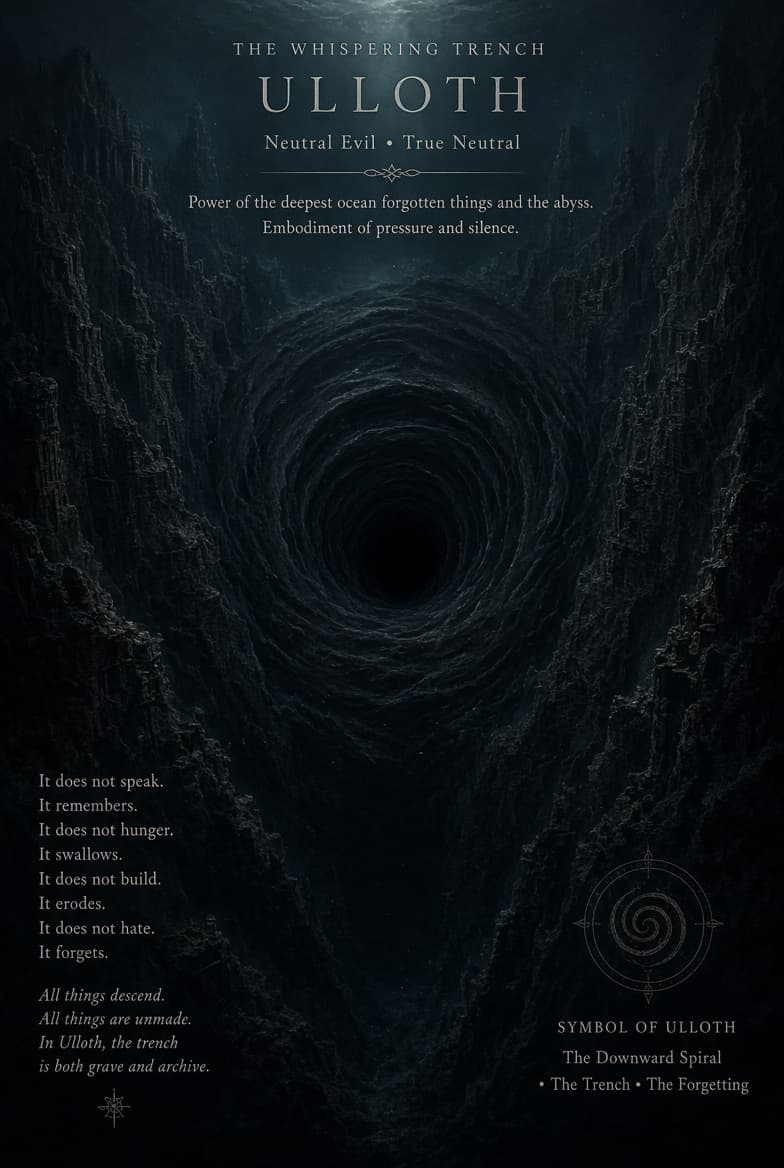
Ulloth
NEthe Whispering Trench
the deepest ocean · forgotten things · entropy · the pressure of the abyss
darkness / death / knowledge
Entropy, Fear, Memory, Oceans
Associated with the deepest trenches and the most ancient undersea ruins. Rarely commands large surface cults, but the name is spoken with caution by all seafarers. Isolated deep-sea merfolk, certain aquatic elves, doomsayers, and those who delve into the most dangerous ruins are the primary worshippers. Shrines, when they exist at all, are found in crushing depths or in places where the pressure of the abyss can be felt.
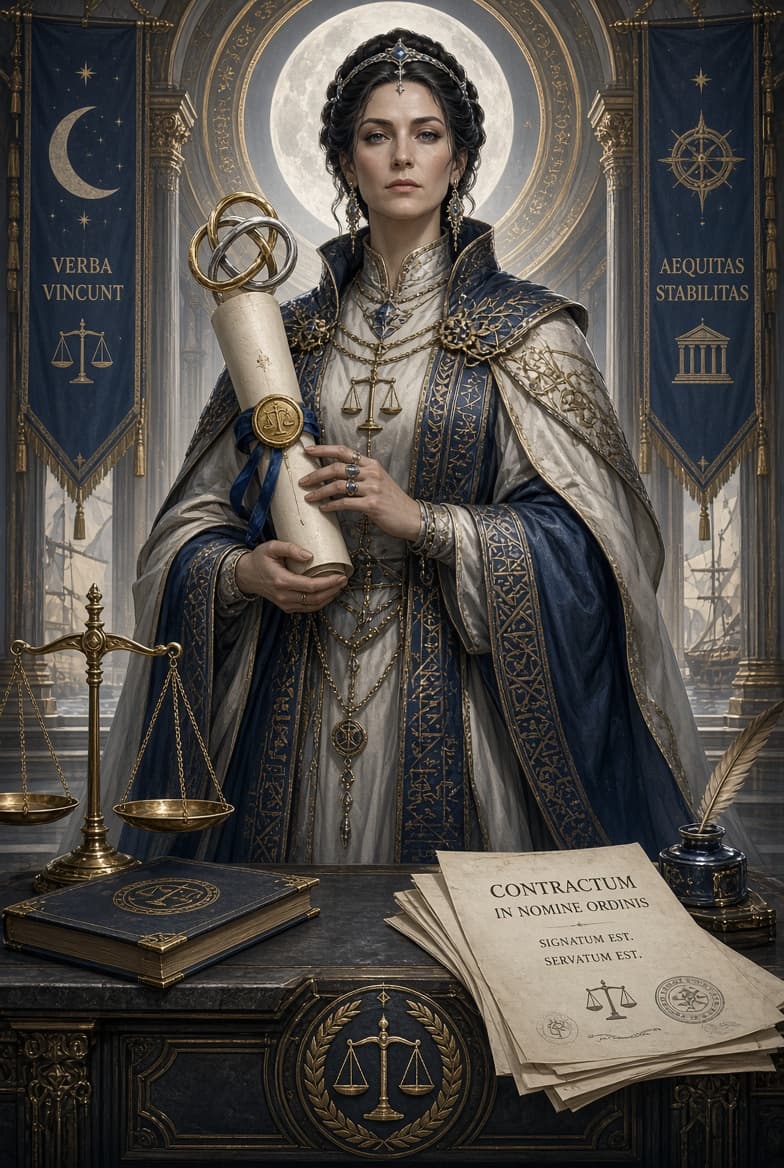
Ashara
LNthe Binder
oaths · contracts · the balance of trade · the Moonfall Compact
law / protection / community
Loyalty, Resolve, Trade, Wards
A relatively “young” major deity whose rise is tied to the need for stable rules governing the island straits and multi-racial trade. Often venerated alongside Morwen. Diplomats, judges, major merchant houses, and city governments are her primary adherents. Temples commonly serve as halls of contract and arbitration; many contain permanent records of the Moonfall Compact and later treaties.
The year
Thirty days to a month, four weeks to a month, and a week that runs one full turn of Ilyra. The calendar is the inner moon wearing civil clothes.
Tidebirth
spring
Swiftcurrent
spring
Raincall
spring
Longlight
summer
Highheat
summer
Emberfall
summer
Harvestide
autumn
Mistveil
autumn
Stormwatch
autumn
Leafturn
winter
Frostedge
winter
Yearclose
winter
The water
Eighty percent of the surface is water, and it is not neutral. Currents decide who trades with whom; the rest of this list decides who comes home.
The record
Merfolk and elves before anyone was writing it down; dwarves in the rising mountains; then humans learned to read the currents, and everything since has been an argument about who controls the straits.
Before reckoningAge 1 of 6
The world cooled and the oceans settled into their current high coverage. Merfolk and the ancestors of aquatic elves arose first in the warm shelf seas and reefs; surface elves appeared in the primeval Boreal forests; the first dwarves awoke in the rising, tectonically active mountains. Knowledge from this age survives only in elven oral epics, dwarven stone-carved chronicles, and merfolk song-cycles of the time when the moons sang the waters into place.
Turning points
12,000 – 7,000 years agoAge 2 of 6
Dwarven clan-holds spread through the highland spines of both continents, mining the ores of ongoing volcanism. Surface elves founded long-lived woodland realms on the Boreal continent, mastering arcane magic tied to Elandra's slow cycles. Merfolk kingdoms expanded across the continental shelves, building coral-and-stone cities and the first undersea trade networks. Humans existed only as scattered coastal tribes; halflings and gnomes appeared in small numbers.
Turning points
7,000 – 4,000 years agoAge 3 of 6
Humans mastered ocean-going vessels. Riding the major currents — especially the Boreal Stream and the early Arc Throughflow — they rapidly colonized the coasts of both continents and the larger islands of the connecting chains. Their numbers, adaptability, and aggressive seamanship founded the first true surface maritime powers, displacing or absorbing many elven coastal forests and dwarven outposts through war, treaty, or intermarriage (producing the first significant half-elf populations). Halflings proved natural partners, settling the newly claimed island farmlands.
Turning points
4,000 – 1,800 years agoAge 4 of 6
Control of the island chains became the central geopolitical prize. A succession of human sea-kingdoms, elven island principalities, and mixed human-halfling republics rose and fell fighting over the key straits of the Arc Throughflow. Dwarven holds reached their greatest extent; gnomes flourished on the more active volcanic islands; goblin and kobold tribes expanded across the harshest islets.
Turning points
1,800 – 600 years agoAge 5 of 6
No single power managed to hold the entire island bridge for long. The Boreal continent consolidated into several large human kingdoms allied with — or dominated by — powerful dwarven clans and residual elven forest realms, while the Southern continent developed independent, often competing human port-cities focused on warm-water trade. Merfolk kingdoms reached a high point of organization, forming loose undersea confederations able to tax or close major shipping lanes.
Turning points
600 – 0 years agoAge 6 of 6
The current balance of power is multipolar and trade-driven. Human kingdoms and city-states remain the most numerous surface powers on both continents; halfling merchant consortia exert enormous economic influence across the island chains without needing formal empires; dwarven holds control high-quality metal production; surface elves preserve their ancient forest domains; merfolk and aquatic elves dominate the open oceans and shelves. The great strategic reality remains unchanged: whoever influences the Arc Throughflow controls the flow of goods, people, and ideas between the two continents.
Turning points
Pathfinder 1st Edition
Write a campaign in Thalor — AI-assisted, or not — a world waiting for your stories. Homebrew anything; it’s yours. Then run it and let your friends join and play.
Thalor orbits Helion (G2V (Sun-analog)) — in our sky, Tau Ceti / HD 10700, 12 light-years out.


